Word of the Day
Word of the Day
/do.le.ni/
Probable Classes: temporal noun, anatomical-descriptive noun, verb, contextual adjective.
Base function
Designate the configuration of a hand completely closed, with the fingers collected, or the act of bringing the hand to this configuration.
By symbolic extension, it also designates Sunday, the first day of the week in the calendar organization of the Uomeh.
Main senses
1. Closed hand — noun
Designates the anatomical configuration in which the fingers are completely retracted, forming a closed hand.
The word describes the resulting configuration, regardless of the cause, muscular intensity or voluntariness.
2. Completely close your hand — verb
Expresses the action or process of closing the hand until reaching complete configuration.
Its semantic core is:
closing movement → full collection of fingers → hand completely closed.
The verb does not necessarily imply force, excessive muscular tension, aggressiveness or intention to strike.
It differs from sahpə̃ pas̆wå, which expresses closing the hand without specifying whether the closure is partial or complete.
3. Closed — contextual adjective
It features a hand that presents the complete closure configuration.
It does not necessarily mean tight, contracted involuntarily, or prepared to strike.
4. Sunday — temporal noun
Designates the first day of the week, located after tesfu (Saturday) and before tuli (Monday).
This meaning is conventional and does not presuppose rest, religious celebration or absence from work.
Lexical distinction
doleni — hand completely closed, close the hand completely; Sunday.
sahpə̃ pas̆wå — close the hand, without mandatory specification of the degree of closure.
doləny — involuntary or difficult to control contraction of the hands, associated with tension, neuromuscular changes or autistic crises.
dolətu - punch; punch, strike a blow.
The difference between doleni and doləny is not in the intensity of the applied force, but in the semantic content:
-
doleni identifies a configuration or the closure that produces it.
-
doləny identifies a particular process of involuntary or difficult-to-control contraction.
-
dolətu identifies a striking action.
Etymology
doleni /do.le.ni/ would have emerged from the lexicalization of the old expression dola e̊ nyẽ, literally “finger associated with the absence of internal content”.
The expression evoked the image of fingers collected over the palm, forming a completely closed hand, even without holding any object.
The proposed phonetic evolution is:
dola e̊ nyẽ → dolenyẽ → dolenĩ → doleni
The process comprises the contraction of /a.e↓/ into /e/, the coalescence of /ɯ.ẽ/ into /ĩ/ and the subsequent loss of nasalization, producing /i/.
The resulting shape came to designate both the configuration of the hand completely closed and the action of closing it until reaching that configuration.
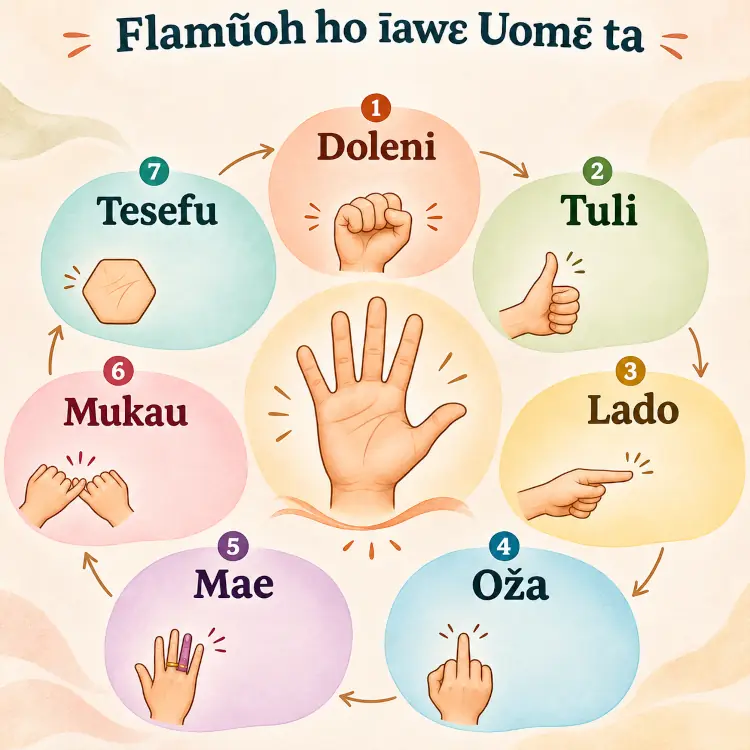
Subsequently, the image of the five fingers collected was symbolically associated with the beginning of the week. In the calendar representation of the Uomeh, Sunday corresponds to the initial meeting of the five fingers, Monday to Friday represent their individual development and Saturday represents the body of the hand that supports them.
The etymological reference to the absence of content does not limit current uses: a hand can be completely closed even though it contains something.
Like this, doleni also acquired the meaning of Sunday, through a symbolic interpretation of the human hand as a representation of the seven days of the week.
This representation considers seven elements: the five fingers, the body of the hand and the configuration of the hand as a whole.
In the calendar organization of the Uomeh:
-
Sunday: the hand completely closed, representing the initial meeting of the elements and the beginning of the weekly cycle.
-
Monday to Friday: the five fingers, considered individually, representing the succession of the five days.
-
Saturday: the body of the hand, the structure that supports and integrates the five fingers.
In this way, the five fingers, the body of the hand and their joint configuration constitute a symbolic representation of the seven days of the week.
At the end of Saturday, the hand symbolically returns to the closed configuration, representing the restart of the weekly cycle on Sunday.
- Doleni, wa hā kas̆imī.
Node Sunday, I will work. - Doleni, wa hā tɔtɔ’ nymatũ.
Node Sunday, I will stay at home. - Tɔs̆im doleni.
This is a closed hand.