


Word of the Day
Word of the Day
/do.lʌ.nɯ/
Base function
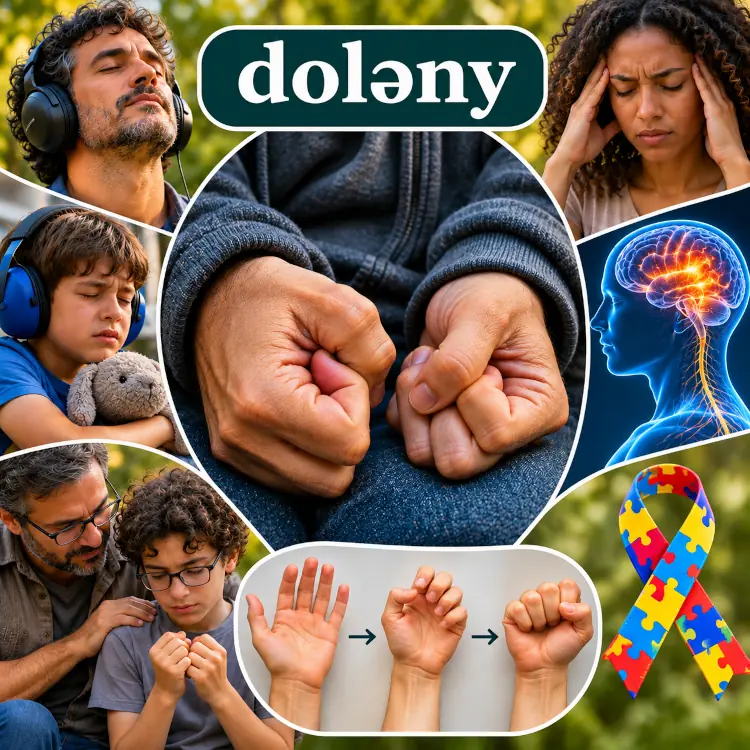
Expressing the involuntary or difficult to control contraction of the hands, characterized by the retraction, stiffening or closing of the fingers in response to physical, emotional, sensory or neuromuscular tension.
doləny describes both the process of contraction and its occurrence as a bodily phenomenon.
Its semantic core is:
involuntary tension or activation → retraction or contraction of the fingers → reduction of voluntary control over the configuration of the hands.
The word does not require that the hand be completely closed nor that the contraction be painful or particularly intense. The essential element is the difficulty in voluntarily controlling the movement or contraction.
Main senses
1. Involuntary contraction of the hands — noun
It designates the bodily phenomenon in which the fingers and, eventually, other structures of the hand contract or retract in an involuntary or difficult to control manner.
It can manifest itself as:
-
involuntary closing of the fingers;
-
stiffening of the hand;
-
repetitive retraction of the fingers;
-
contraction sustained for a certain period;
-
momentary difficulty relaxing or opening your hand.
These manifestations do not need to occur simultaneously.
The meaning does not, by itself, determine the cause, duration or intensity of the contraction.
2. Involuntarily contract your hands — verb
Expresses the occurrence or development of the hand contraction process, without presupposing a conscious intention to close them.
It may correspond, depending on the context, to:
involuntarily contract your hands, suffer a twitch of your hands, present involuntary twitching of your fingers.
The verb can describe a passing, recurring or prolonged contraction.
Unlike a verb that describes a voluntary action, doləny it does not presuppose that the subject has decided to produce the movement.
Occurrence contexts
The contraction expressed by doləny may arise in different circumstances.
Emotional or physical tension
The person presents hand contractions during a situation of tension, anxiety, effort or overload.
Neuromuscular changes
The contraction results from muscular or neurological processes that make voluntary control of the fingers and hands difficult.
Autistic crises and sensory overload
In some autistic people, episodes of dysregulation or overload may involve involuntary or difficult-to-control contractions of the hands.
In this context, doləny specifically names the bodily manifestation, and not the autistic crisis in its entirety.
The word does not assume that all autistic people exhibit this behavior nor that all hand twitching is related to autism.
Lexical distinction
doleni — configuration of the hand completely closed or the act of closing it completely, regardless of the cause or intensity. It also designates Sunday.
sahpə̃ pas̆wå — close the hand, without necessarily determining the degree of closure.
doləny — contracting your hands involuntarily or with difficulty controlling them; involuntary contraction of the hands.
dolətu - punch; punch, strike a blow.
tə̃nyh — retract, withdraw or fold inwards, without necessarily specifying involuntary contraction.
The fundamental distinction is that:
-
doleni focuses on the complete configuration or its production.
-
doləny focuses on involuntary or difficult-to-control contractions.
-
dolətu focuses the strike.
-
tə̃nyh focuses on the inward movement.
A contraction called doləny may result in doleni, if the hand is completely closed. However, this is not mandatory.
Likewise, a person can perform doleni voluntarily, without presenting doləny.
Grammatical usage
As a noun, doləny names the contraction itself or an episode of this phenomenon.
As a verb, it expresses the occurrence or development of the contraction, and can normally receive the temporal, aspectual and modal particles of the Uomeh.
The alternation between noun and verb does not require a change in the lexical form.
The verb can be used with the person presenting the contraction as the subject or, depending on the construction, with the person presenting the contraction as the subject.
dola ho tə̃nyh (fingers collected) → dola tə̃nyh → dola nyh → dolanyh → doləny
1. Ho suppression
The explicit plural mark loses its need during lexicalization, as the set of fingers is already incorporated into the meaning of the new word.
2. Tə̃nyh reduction
The initial sequence tə̃ disappears through reduction, preserving the segment nyh, historically associated with the inward movement.
This reduction is a specific hypothesis for the formation of doləny, not a general tə̃ suppression rule.
3. Agglutination
The reduced expression dola nyh is now pronounced and interpreted as a single lexical unit:
dola nyh → dolanyh.
4. Vowel centralization and loss of h
The vowel /a/ of the second syllable is centered on /ʌ/, represented orthographically by ə in internal position.
The final consonant h disappears, producing the modern form:
/do.la.nɯh/ → /do.lʌ.nɯ/
doləny.
These steps represent a plausible lexical reconstruction, without constituting general laws of phonetic evolution of the Uomeh.
Semantic development
The proposed conceptual evolution is:
fingers that retract inwards → muscular retraction of the fingers → contraction of the hands → involuntary or difficult to control contraction.
The originally descriptive expression specialized in the designation of a specific bodily phenomenon, distinguishing itself from the simple voluntary closing of the hand.
-
Mā pas̆wå ho le dō doləny.
Her hands are contracting involuntarily. -
Wa s̆u doləny.
I I involuntarily contracted my hands. -
Wa s̆u hūnhca doləny.
I felt a involuntary twitching of the hands. -
Mā pas̆wå ho wa s̆u doləny.
My hands contracted involuntarily. - Le s̆u e̊mā doləny.
She had a autistic crisis.
Synonyms:
- involuntary twitching of the hands